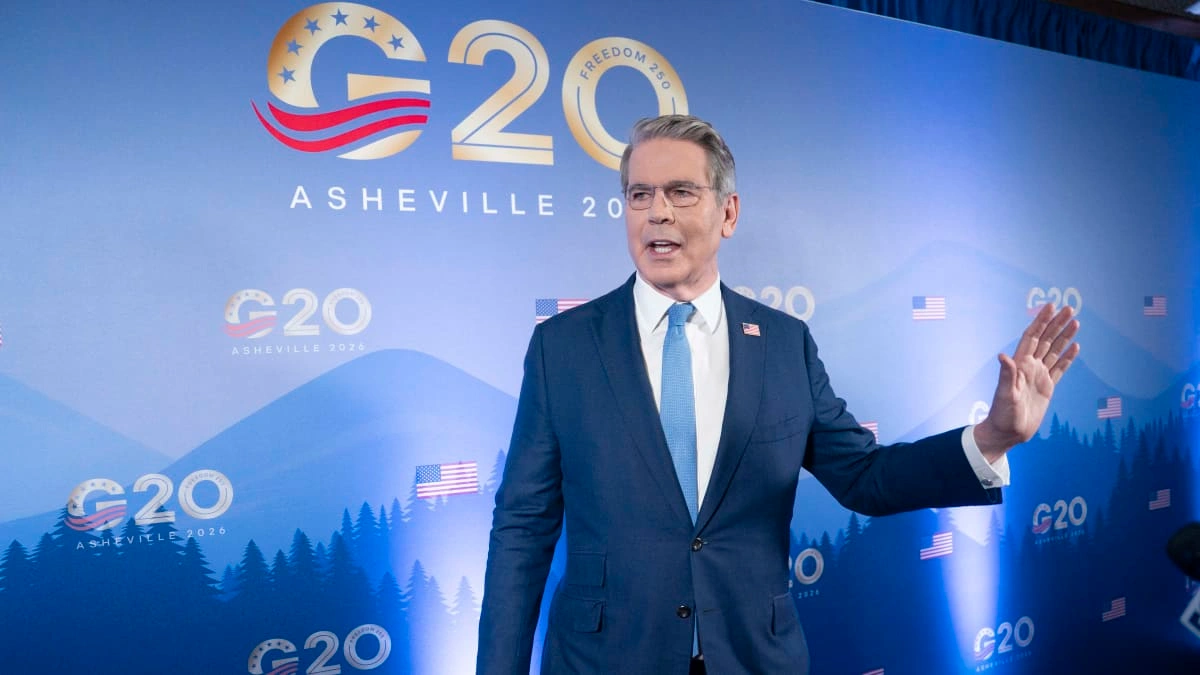
The United States is using this year's G20 finance meeting to push a simple message: the world's biggest economies need to grow faster if they want to deal with their growing mountain of debt.
Finance ministers and central bank chiefs from the G20 countries are meeting in Asheville, North Carolina, as the global economy faces several problems at the same time. Energy prices have been affected by the war involving Iran, trade tensions with China remain high and governments are carrying record levels of debt.
Global debt reached nearly $353 trillion earlier this year, raising concerns about financial stability and the ability of governments to keep borrowing without putting further pressure on markets.
US Treasury Secretary Scott Bessent made economic growth one of the central themes of the meeting. He argued that countries cannot simply rely on cutting debt while their economies remain weak.
Bessent's approach is to encourage policies that make it easier for businesses to invest, expand and hire workers.
He pointed to excessive regulation, complicated tax systems, limited investment, fragmented domestic markets and shortages of skilled workers as some of the obstacles holding economies back.
The argument from Washington is that stronger economic activity would make large debt burdens easier to manage because governments would have larger and healthier economies from which to generate revenue.
America wants the private sector to take a bigger role
The Trump administration has been pushing deregulation and increased energy production as ways of encouraging economic growth, and those ideas are now being taken to the G20 table.
US officials are presenting the American economy as an example of what they believe can happen when private investment is given more room to expand.
Artificial intelligence has become an important part of that story.
The huge investment going into AI infrastructure in the United States is helping drive demand for data centres, electricity, technology equipment and other services. Federal Reserve Chair Kevin Warsh described the current period as a global investment surge, saying it has changed the way money is flowing through the world economy.
But that investment boom is also having an effect on financial markets.
Heavy investment requires capital, and increased demand for borrowing can push interest rates higher. Higher US Treasury yields have therefore attracted close attention from investors who are already watching Washington's debt and budget deficits.
Bessent, however, has rejected the idea that the US is currently experiencing a major bond-market crisis. He has argued that continued economic growth puts the United States in a stronger position than some other heavily indebted economies.
China is another major issue in the room
The meeting is also taking place against the backdrop of growing disagreement between Washington and Beijing over trade.
The United States wants China to reduce its dependence on exports and encourage more spending by Chinese consumers at home.
Bessent has criticised China's enormous trade surplus, which Reuters reports has reached around $1.2 trillion.
Washington's argument is that such a large surplus contributes to imbalances in the global economy. The US wants Beijing to shift more of its economic strength toward domestic consumption instead of relying so heavily on overseas demand.
For China, however, changing the structure of its economy is not something that can happen overnight.
Chinese manufacturers have built enormous export industries, while weaker domestic demand has made overseas markets increasingly important for many companies.
That puts the issue directly into the wider US-China trade dispute.
Iran and the Strait of Hormuz are also affecting the meeting
The G20 gathering is happening at a particularly difficult time for energy markets because of the conflict involving Iran and the disruption around the Strait of Hormuz.
The waterway is a crucial route for global energy shipments, so prolonged disruption can push up oil prices and increase inflationary pressure in economies far from the Middle East.
Washington is also seeking international support for stronger economic pressure on Iran, including efforts to isolate Iranian financial institutions and reduce the country's ability to maintain trade relationships.
That creates another challenge for the United States because some major economies have their own economic interests in maintaining trade with Iran.
China, in particular, is a major buyer of Iranian oil, making Beijing an important part of any international effort to increase economic pressure on Tehran.
Canada trade tensions add another problem
The United States is also heading into discussions with Canada at a time when trade relations between the two neighbours have become more difficult.
Canada has announced counter-tariffs after negotiations aimed at avoiding new US tariffs broke down.
Bessent is expected to meet his Canadian counterpart on the sidelines of the G20 meeting, giving the two countries an opportunity to discuss the dispute.
The meeting therefore brings together several issues that are increasingly connected.
High debt affects government finances. Higher energy prices feed into inflation. Trade disputes affect businesses and consumers. At the same time, the massive investment required for artificial intelligence is reshaping financial markets.
The United States wants the G20 to concentrate on economic growth as the way through these pressures.
Whether other members agree with Washington's approach remains another question.
Countries facing high debt may want faster growth, but they also have to deal with inflation, interest rates, trade disagreements and domestic political pressures. The challenge is finding policies that can encourage investment without creating another financial problem.
For now, the G20 meeting in Asheville is giving the world's largest economies a chance to debate exactly that.
The message coming from Washington is clear: with global debt approaching $353 trillion, the United States believes the world cannot simply cut its way out of the problem. It needs bigger, stronger economies capable of carrying the debt they already have.





 HOME
HOME Foodies
 Drinks
 Fruits & Veggies
 Supermarket
 Beauty & Health
 Electronics
 Fashion
 Live Tv